


High-Risk Merchant Checklist: What to Look For in a Payment Partner (No-BS Guide)
Posted by By Luis Requejo, HighTech Payment Systems on Nov 14th 2025
High-risk merchants are not “problem businesses.”
They simply operate in industries with higher chargeback ratios, compliance scrutiny, or volatility. But most payment providers treat high-risk merchants like liabilities—not clients.
That’s why high-risk merchants face the same repeated failures:
-
sudden account shutdowns
-
rolling reserves with no end date
-
payout holds
-
unexplained rate increases
-
arbitrary volume caps
-
aggressive chargeback penalties
-
clueless support teams
-
compliance traps
-
fraud exposure
-
unreliable global routing
These failures aren’t caused by the merchant.
They’re caused by weak payment providers pretending to be “high-risk specialists.”
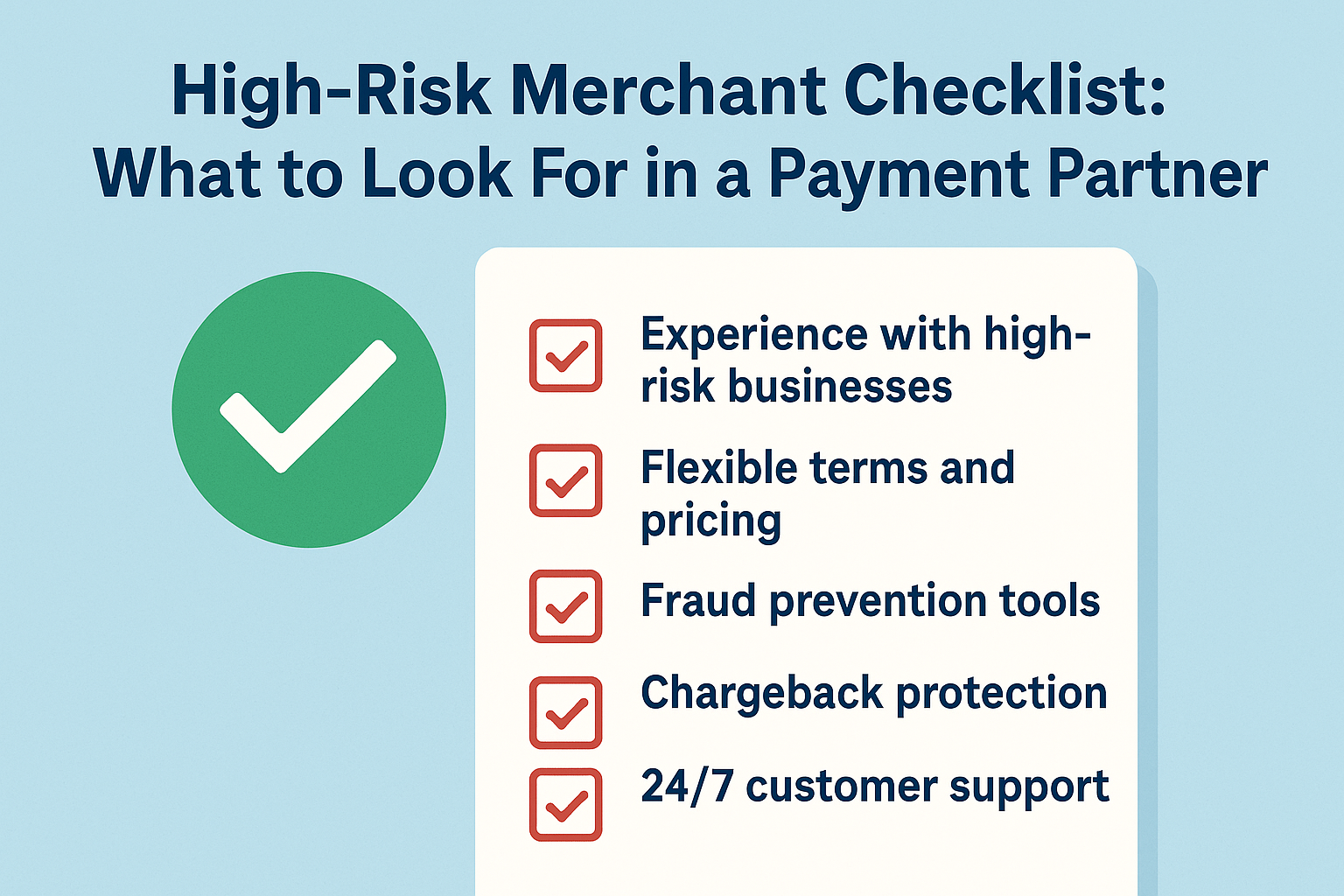
This article gives you the non-negotiable checklist to evaluate any high-risk payment partner—and avoid the partners that collapse the moment your business scales.
1. Real High-Risk Underwriting (Not Rushed Approvals)
Weak processors approve merchants fast because they want the sale.
Strong processors approve merchants carefully because they want stability.
You must demand:
-
documented underwriting criteria
-
MCC classification clarity
-
review of marketing claims
-
review of fulfillment timelines
-
review of refund policies
-
evaluation of chargeback risk
-
review of processing history
-
volume forecast alignment
If underwriting feels too easy, it is guaranteed the provider will punish you later with:
-
payout freezes
-
rate increases
-
surprise reserves
-
eventual termination
Red flag:
“Guaranteed approval” or “instant onboarding.”
That’s code for unstable underwriting.
2. Transparent Reserve Policies (Real Schedules, Not Vague Promises)
Every high-risk provider uses reserves.
That’s normal.
What’s not normal is how most abuse them.
Require written details on:
-
reserve %
-
reserve schedule
-
release timeline
-
conditions for reduction
-
maximum reserve cap
-
events that trigger increases
If the provider won’t put reserve terms in writing, walk away.
Red flags:
-
“Standard high-risk reserve applies.”
-
Reserve held indefinitely.
-
Reserve increases without notice.
Reserves shouldn’t cripple your cash flow—they should manage risk predictably.
3. Stable, Predictable Funding (Not Random Payout Holds)
High-risk merchants must obsess over cash flow.
A provider with unpredictable payouts will kill your operations.
Demand clarity on:
-
payout timelines
-
cutoff times
-
weekend logic
-
holiday delays
-
regional settlement impacts
-
reserve interactions
-
triggers for payout holds
Red flag:
“Typical payout time: 24–48 hours.”
That vague range means they hide inconsistent settlement logic.
4. Real Fraud Prevention Built for High-Risk Environments
High-risk merchants deal with:
-
stolen cards
-
bot traffic
-
affiliate fraud
-
refund fraud
-
reseller abuse
-
triangulation fraud
-
promo exploitation
-
subscription risk
-
synthetic identities
Most processors don’t have the tools to detect these.
Demand fraud infrastructure with:
-
machine learning scoring
-
device fingerprinting
-
behavioral analytics
-
velocity monitoring
-
proxy/VPN detection
-
BIN intelligence
-
geo-risk scoring
-
3D Secure 2.0 optimization
-
pre-auth risk evaluation
-
risk-based authentication
Red flag:
Fraud system = AVS + CVV only.
That’s prehistoric tech.
5. Chargeback Management That Actually Works
Weak processors only notify you of chargebacks.
Strong processors help you win them and reduce them.
Demand capabilities such as:
-
real-time alerts
-
automated representment
-
integrations with Visa/MC alert systems
-
dispute reason analysis
-
evidence templates
-
chargeback ratios by descriptor
-
fraud vs. non-fraud classification
-
win rate reporting
-
subscription-specific workflows
Red flag:
They outsource chargeback management to a third party.
That means no internal risk control.
6. Volume Scalability Without Penalties
High-risk merchants often scale fast. Most processors cannot handle it.
You must ask:
-
What are daily and monthly caps?
-
How are caps reviewed or increased?
-
What triggers a re-underwriting event?
-
Do they throttle traffic during spikes?
-
Can they process seasonal volume fluctuations?
Red flag:
Provider freezes payouts when you exceed a cap you didn’t know you had.
If they can’t support your growth, they will punish your growth.
7. Clear Pricing That Doesn’t Change Once You Scale
High-risk pricing is higher than low-risk pricing—that’s a fact.
But unstable pricing is unacceptable.
Demand pricing transparency on:
-
high-risk merchant rates
-
international card fees
-
cross-border markups
-
chargeback fees
-
retrieval fees
-
monthly fees
-
gateway fees
-
reserve-related fees
-
account review fees
-
early termination fees
Red flag:
Provider increases your rate after a chargeback spike without explanation.
That means they never properly underwrote your risk.
8. Global Payment Support That Actually Functions
Most high-risk merchants sell internationally.
Most payment providers pretend they support global markets.
Demand true global capabilities:
-
multi-currency processing
-
multi-currency settlement
-
local acquiring
-
regional routing
-
low-latency global infrastructure
-
local payment methods (SEPA, PIX, iDEAL, etc.)
Red flags:
-
all payments routed through the U.S.
-
USD-only settlement
-
vague global coverage lists
If they can’t handle international payments, your conversions will tank.
9. Real Compliance Experience (Not Generic Buzzwords)
High-risk merchants live under scrutiny.
Your provider must understand:
-
FTC rules
-
FDA restrictions
-
subscription billing compliance
-
claim substantiation
-
privacy laws
-
banking regulations
-
MCC classifications
-
KYC/AML
-
GDPR requirements
-
cannabis, CBD, supplements, coaching, adult vertical laws
Demand proof:
-
compliance team
-
regulatory experience
-
certification documents
-
onboarding checklists
Red flag:
Provider doesn’t review your website before approval.
That’s underwriting malpractice.
10. Strong Technical Infrastructure (Not a White-Label Platform)
Many “high-risk processors” are just reskinned platforms of bigger gateways like:
-
NMI
-
Authorize.net
-
Network Merchants
-
Payrix
-
Stripe resellers
-
Fiserv clones
They don’t operate their own infrastructure.
Demand transparency:
-
Who owns the tech stack?
-
Who processes the transaction?
-
Who stores the data?
-
Do they own the token vault?
-
What’s their uptime?
-
Where are their data centers?
Red flag:
They say: “We use industry-leading partners.”
Translation:
They don’t actually process anything.
11. Support From Real Risk Analysts, Not Script Readers
High-risk merchants need support from people who understand:
-
chargebacks
-
merchant category compliance
-
underwriting
-
processing logic
-
reserves
-
fraud scoring
-
risk thresholds
Demand:
-
dedicated risk analyst
-
dedicated account manager
-
escalation path
-
real-time support options
Red flag:
Support can’t explain why a payout was frozen.
This means they have zero control over the system.
12. A Long-Term Business Relationship—Not a Quick Sale
High-risk merchants aren’t looking for approval.
They’re looking for stability.
A real high-risk payment partner:
-
explains risk honestly
-
warns you about problems early
-
works on reducing chargebacks
-
helps optimize your processing
-
prepares you for scaling
-
builds long-term stability
Weak providers rely on:
-
rushed approvals
-
vague contracts
-
hidden reserves
-
sudden freezes
-
arbitrary rule enforcement
A high-risk merchant doesn’t need another liability—they need predictable, transparent processing.
Final Verdict: A High-Risk Merchant Needs a High-Risk Partner—Not a High-Risk Gamble
Most high-risk merchant failures come from one cause:
They picked a payment provider who wasn’t built for high-risk.
Your revenue depends on choosing a partner with:
-
strong underwriting
-
transparent reserves
-
stable payouts
-
real fraud prevention
-
effective chargeback tools
-
scalable infrastructure
-
global support
-
clear pricing
-
real compliance
-
expert-level support
Anything less is a business risk you cannot afford.
Use this checklist ruthlessly.
Most providers will fail it.
The few that pass it are the only ones worth trusting.